1975
 Console
AtariConsole5 variants
Atari Dedicated Console Era
Atari’s home Pong machines and dedicated follow-ups brought the arcade idea into the living room.
- Platform
- First generation
- Format
- Built-in games
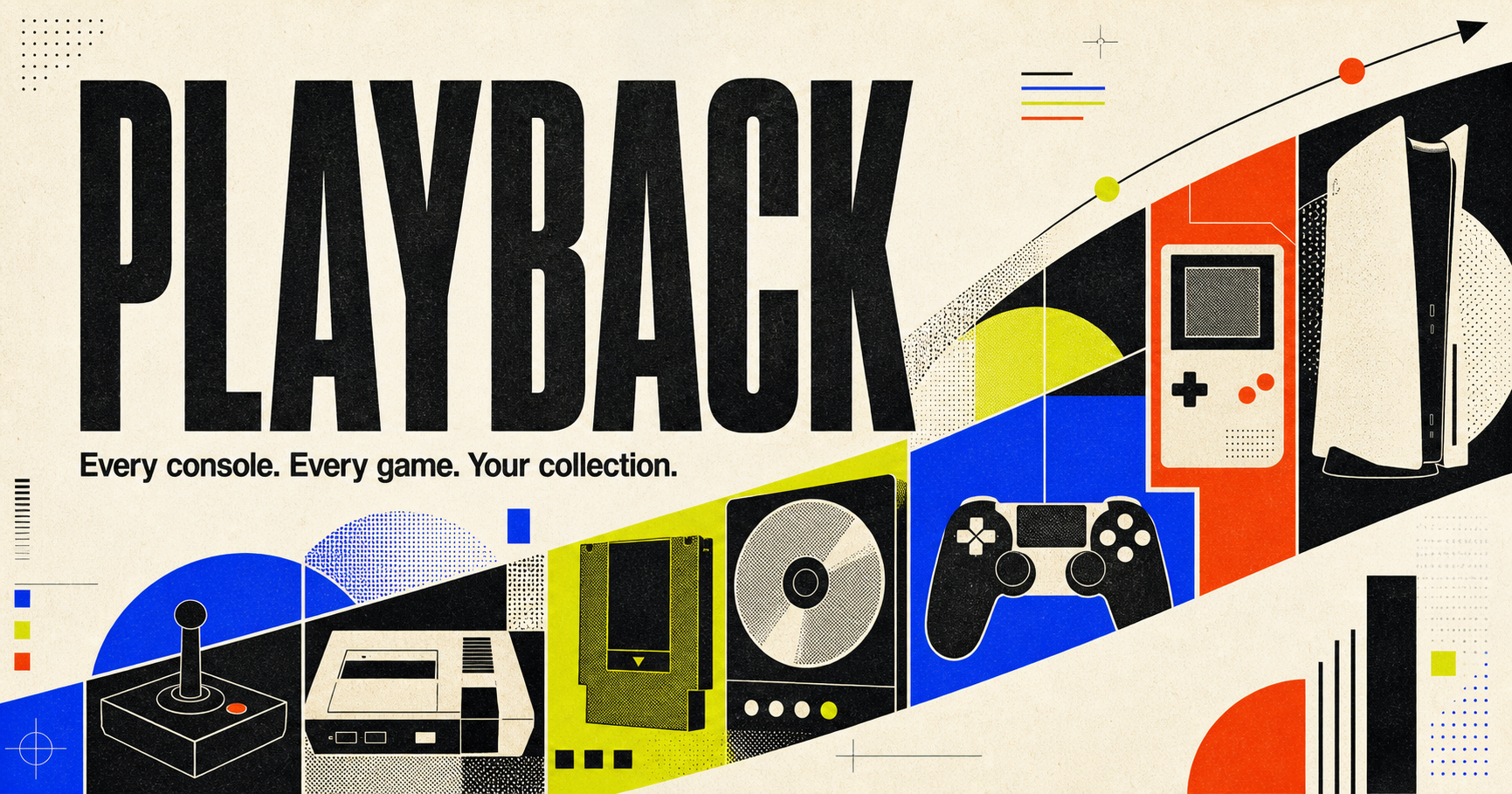
A living history of play
Trace the machines, games, and ideas that shaped how we play—then build a personal shelf from the history you own.
Browse the collection
91 catalog entries · 1975—2025 · oldest first
Atari’s home Pong machines and dedicated follow-ups brought the arcade idea into the living room.
The wood-grain machine that brought interchangeable game cartridges into millions of homes.
The expanded sibling to Color TV-Game 6 added detachable controllers and more variations.
Nintendo’s first home console packed six Pong-style variations into a bright orange shell.
A tabletop steering wheel and gearshift turned Nintendo’s third TV game into a miniature arcade.
Nintendo’s dedicated block-breaking machine carried one of Shigeru Miyamoto’s earliest hardware designs.
A rare home version of Nintendo’s Computer Othello arcade game closed the Color TV-Game era.
Pocket LCD games, a clock, and the first cross-shaped D-pad made portable play an everyday object.
Atari’s large-format follow-up paired upgraded arcade conversions with analog controllers.
The red-and-white Famicom established Nintendo’s cartridge console platform in Japan.
Sega’s keyboard-equipped companion to the SG-1000 bridged home computing and cartridge games.
Sega’s first home video game console began the hardware lineage that led to the Master System.
A precise grey box, a strict seal of quality, and a library that rebuilt the console business.
Sega’s upgraded 8-bit platform evolved from the Japanese Mark III into the worldwide Master System.
A backwards-compatible Atari console designed for stronger arcade-style graphics.
A disk-drive add-on enabled larger games, save data, and inexpensive rewritable releases.
A console-styled version of Atari’s 8-bit computer platform with detachable keyboard support.
Sega’s 16-bit flagship paired fast arcade-style games with a bold worldwide identity.
A color handheld with ambidextrous controls, hardware scaling, and linked multiplayer.
Modest hardware, exceptional battery life, and Tetris made portable play a global habit.
A full-color Sega handheld with a broad international library and many collectible shell colors.
Nintendo’s rounded Japanese 16-bit system arrived with richer color, sound, and visual effects.
Sega’s CD-ROM platform expanded the Mega Drive with red-book audio, video, and larger games.
A refined 16-bit console remembered for expressive sound, color, and all-time-great games.
Atari’s final original home console emphasized custom multi-chip hardware and arcade ambitions.
Compact top-loading revisions gave Nintendo’s 8-bit hardware a simpler, more reliable final form.
A child-focused learning console built around illustrated books, a touch pad, and a stylus.
Sega’s portable 16-bit branch moved from the screenless Mega Jet to the self-contained Nomad.
A powerful 2D-focused CD console whose Japanese hardware range became a collector favorite.
A cartridge-slot expansion that added twin 32-bit processors to the Mega Drive and Genesis.
A top-mounted CD-ROM expansion that turned the Jaguar into a dual-format system.
Sony’s confident debut helped move games onto discs, into 3D, and toward an older audience.
A satellite modem delivered scheduled games, magazines, and live audio to Super Famicom players.
A red stereoscopic display delivered depth without glasses, but comfort and software limitations cut its life short.
A smaller body and a sharper true black-and-white screen modernized the original Game Boy.
An analog stick and four controller ports made 3D movement and couch multiplayer click.
Sega’s final traditional home console joined arcade-grade 3D graphics with built-in online features.
Color graphics and broad backwards compatibility extended the Game Boy phenomenon.
A Japan-only Game Boy Pocket variant added the family’s first electroluminescent backlight.
A long-delayed magnetic disk drive promised writable storage, expansion, and online creativity.
A DVD player, a huge global library, and years of momentum created a record-setting console.
A wide 32-bit handheld carried Game Boy compatibility into a colorful new generation.
A compact, playful console with a beloved controller and a fiercely distinctive library.
Nintendo’s smallest cartridge system packed a clock, rumble, infrared link, and Pokémon games into a tiny shell.
Microsoft entered the living room with a hard drive, powerful hardware, and online ambition.
A folding design, rechargeable battery, and illuminated screen transformed portable convenience.
A controller-shaped Nintendo 64 system delivered downloadable games for the mainland Chinese market.
A Japanese DVR and media center built around PlayStation 2 hardware.
Two screens, touch input, wireless play, and a microphone opened a different path for handheld design.
Sony’s first handheld paired widescreen portable games with music, movies, and wireless play.
Sega Toys’ successor to Pico added stronger graphics and a two-sided touch-pad layout.
A tiny metal-bodied Game Boy Advance offered a bright screen and interchangeable faceplates.
Achievements, a unified online service, and an early launch shaped the HD console era.
A slimmer case and dramatically brighter displays turned DS into a polished mass-market phenomenon.
A simple motion controller invited families, grandparents, and lapsed players into the room.
A difficult launch gave way to a formidable library and a major role in the Blu-ray era.
Cameras, internal storage, an SD slot, and DSiWare made the DS family more personal and connected.
Larger screens and wider viewing angles made the DSi experience easier to share.
Glasses-free stereoscopic 3D, a Circle Pad, and StreetPass extended Nintendo’s dual-screen idea.
A powerful dual-stick handheld with an OLED debut model and a colorful slimmer revision.
A horizontal Wii revision simplified the hardware and removed GameCube compatibility.
Displays roughly ninety percent larger made stereoscopic handheld games more expansive.
A red-and-black top-loading Wii removed online features to become the family’s smallest budget model.
Nintendo’s first HD console placed a touchscreen GamePad at the center of asymmetric and off-TV play.
A durable wedge-shaped entry model played the 3DS library without stereoscopic visuals.
A focused, developer-friendly console whose sharing features and broad library defined the generation.
The Vita platform moved to television in a tiny controller-driven microconsole.
Microsoft’s third console evolved from an entertainment-centered launch into the smaller One S and more powerful One X.
Faster processing, face-tracked 3D, extra controls, NFC, and swappable covers refreshed the platform.
The larger version of Nintendo’s enhanced 3DS became the upgrade’s primary global model.
A miniature HDMI NES packaged thirty built-in games with save states and display options.
A light clamshell combined New 3DS power and large displays without stereoscopic 3D.
A console that moves between television and handheld play made flexibility the main feature.
Nintendo’s second microconsole celebrated the 16-bit era and officially released Star Fox 2.
A miniature original PlayStation with twenty built-in games and two controllers.
A compact first-model Mega Drive recreation with region-specific branding and game libraries.
A smaller all-in-one Switch focused exclusively on handheld play.
A color-screen anniversary handheld revived Game & Watch with classic Mario games and an interactive clock.
Four tiny playable Game Gear tributes, each color carrying a different four-game library.
Fast solid-state storage and an expressive controller recentered feel and immediacy.
Two performance tiers, deep compatibility, and subscription access reframed the Xbox platform.
A Linux-based living-room system that combines Atari collections, streaming, and an open PC mode.
A green-and-gold Game & Watch collected three Zelda adventures, Vermin, a clock, and a timer.
A vivid seven-inch OLED display, improved stand, and revised dock refined the hybrid system.
A second mini system based on the smaller Model 2 shell and expanded with Mega-CD titles.
An HDMI-equipped, reduced-scale Atari console built to run original 2600 and 7800 cartridges.
My Arcade’s officially licensed Atari systems collect classic console and arcade games in modern living-room and portable hardware.
A dedicated handheld screen and DualSense-style controls built around the PlayStation 5 experience.
A half-scale Atari 400 recreation that emulates the Atari 8-bit family and Atari 5200.
A compact HDMI cartridge system inspired by the original 7800 and paired with a wireless gamepad.
A larger, more powerful hybrid introduced magnetic Joy-Con 2 controllers, mouse controls, and GameChat.
The collector’s view
PLAYBACK connects the big timeline to the objects on your shelf. Save what you own, rediscover why it mattered, and watch your collection become part of a much larger story.
 Console
 Console
 Console
 Console
 Console
 Console
 Console
 Console
 Console
 Console
 Console
 Console
 Console
 Console
 Console
 Console
 Console
 Console
 Console
 Console
 Console
 Console
 Console
 Console
 Console
 Console
 Console
 Console
 Console
 Console
 Console
 Console
 Console
 Console
 Console
 Console
 Console
 Console
 Console
 Console
 Console
 Console
 Console
 Console
 Console
 Console
 Console
 Console
 Console
 Console
 Console
 Console
 Console
 Console
 Console
 Console
 Console
 Console
 Console
 Console
 Console
 Console
 Console
 Console
 Console
 Console
 Console
 Console
 Console
 Console
 Console
 Console
 Console
 Console
 Console
 Console
 Console
 Console
 Console
 Console
 Console
 Console
 Console
 Console
 Console
 Console
 Console
 Console
 Console